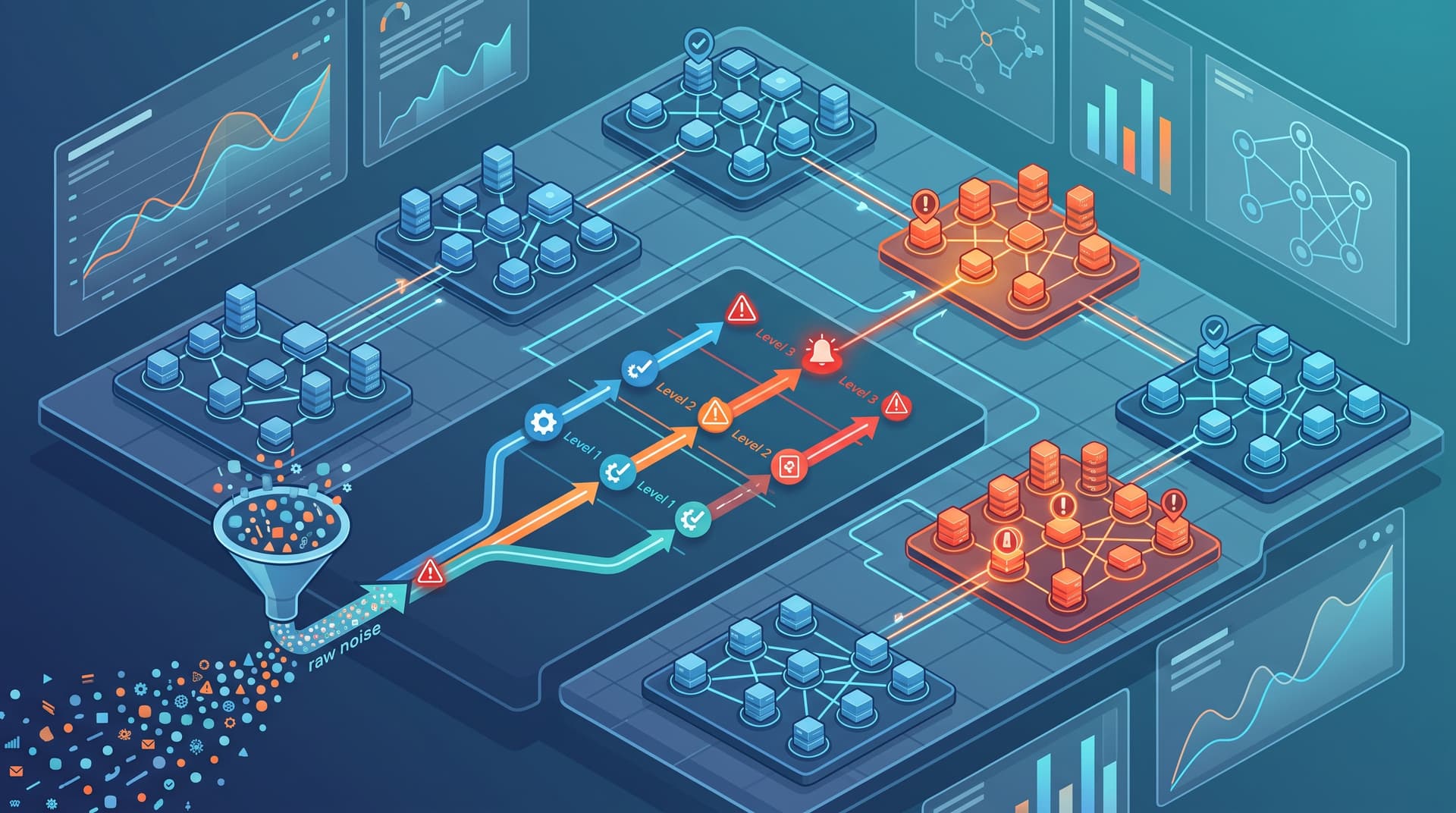
Proactive Alert Triage: Bridging Telemetry to Swift Incident Resolution
Monitoring dashboards frequently glow green while user tickets flood the help desk, or conversely, chime constantly with low-priority warnings that engineering teams learn to ignore. Capturing metrics is simple; converting alerts into rapid, deterministic resolution requires structured operational discipline.
Differentiating Telemetry Gathering from Incident Ownership
Raw infrastructure data provides visibility, but visibility alone does not resolve downtime. Without assigned ownership, alerts sit in unmonitored queues or trigger diffuse responsibility where team members assume someone else is investigating.
To establish true accountability:
- Explicit Incident Ownership: Every alert category must map directly to a primary role or team.
- Executable Runbooks: Alerts should link directly to step-by-step remediation procedures rather than requiring technicians to troubleshoot from scratch.
- Transparent Client Communication: Status updates must be automated and contextual, informing stakeholders before they notice degraded service.
Tuning Thresholds and Structuring Escalation Tiers
Alert fatigue occurs when high-volume, non-critical events obscure genuine emergencies. Optimizing your Remote Monitoring and Management (RMM) platform requires continuous threshold tuning.
Tiered Escalation Matrix
- Tier 1 (Automated Scripting & Triage): Transient spikes, service restarts, and disk cleanup routines execute automatically.
- Tier 2 (NOC / Duty Technician): Persistent warnings requiring human judgment (e.g., recurring latency, failing disk predictive SMART errors).
- Tier 3 (Senior Engineering & Vendors): Severe outages, core network failures, or security breaches requiring specialized intervention.
After-hours routing must adhere to strict severity definitions so critical failures alert on-call personnel instantly, while routine warnings accumulate for morning review.
Multi-Site SMB Strategies: Navigating Uneven Network Quality
Distributed SMB environments often suffer from false positives caused by erratic ISP links or remote site latency. Standardizing alert policies across uniform topologies often fails in real-world conditions.
- Dynamic Alert Suppression: Implement dependency mapping so a WAN link failure does not trigger dozens of downstream device-down alerts.
- Consecutive Check Validation: Require multiple failed polling intervals before triggering critical off-hours pages on flaky connections.
- Local Edge Probes: Deploy lightweight secondary monitoring agents locally to distinguish between complete site downtime and temporary gateway packet loss.
Quantifying Success: Tracking MTTR and Signal-to-Noise Ratios
Improving Mean Time to Resolution (MTTR) relies on measuring the quality of incoming telemetry. Track these key metrics monthly:
- Signal-to-Noise Ratio (SNR): Percentage of generated alerts that result in action vs. closed without action.
- Mean Time to Acknowledge (MTTA): Speed at which an assigned owner takes responsibility for an alert.
- Runbook Coverage Rate: Percentage of high-severity alerts associated with validated, up-to-date remediation steps.
Conclusion
Transforming reactive alert noise into proactive resolution requires deliberate threshold tuning, documented runbooks, and disciplined escalation tiers.
Is alert noise hindering your team's efficiency? Ask Bitscaled to tune monitoring thresholds and define alert ownership for your environment.